
You are using an out of date browser. It may not display this or other websites correctly.
You should upgrade or use an alternative browser.
You should upgrade or use an alternative browser.
25 and older
- Thread starter Hollidae
- Start date

nightfly71
Active member
I think 25 is still near peak, its what comes after that that sucks
I was fine at 25, really. I didn't notice much until prob a yr. or two ago, which was 34-35 for me. Nothing big, but just little things like a bit more in the aches and pains dept. A little more recession in the hairline, cutting getting harder to do than before. Things like that. I still feel like I'm doing well for my age, though, compared to a lot of other guys.

LilPsychotic
Well-known member
I don't know, I turned 26 a few months ago and I noticed that recovery is definately slower than it was a couple years ago. Also, I really have to watch what I eat. I hold on to fat alot easier. When I was 21, I'd eat burger king 3 times a day and was still just as cut (if not more) than I am now. Now I have to diet for 12 weeks to lose unwanted belly fat, and it comes back as soon as I stop dieting strictly. Injuries also hang around longer. F'in sucks.
.
.


Carbocation
New member
how does the male body change at 25. what should i expect
everybody is different... i feel better now at 32 than i did when i was 25.... real life begins at 30!!!

strategicmove
Legend
In about eight years, you'd probably say "real life begins at 40"!Carbocation; said:everybody is different... i feel better now at 32 than i did when i was 25.... real life begins at 30!!!


jmh80
Well-known member
everybody is different... i feel better now at 32 than i did when i was 25.... real life begins at 30!!!
I look a helluva lot better now at 27 than 19, 20, 21.

de1060
New member
i'll be 28 in a few weeks, and i'm actually leaner, meaning, and smarter than i was back in high school. working smart not hard really goes a long way in the gym. but then, i was never one of those guys who could eat anything they want and not get fat. so in a way, just being a little bit smarter about taking care of myself has more than made up for any lack in recovery time.
Carbocation
New member
all i know is that at 32 i am not bald... hope it stays that way. i do have some grey hair though lol!!
someone said their metabolism went to crap... very true... gotta watch what you eat... no more eating sweet stuff all time thats for sure... and i cut out the soda pop... i cant seem to cut out the coffee though :whiner:
someone said their metabolism went to crap... very true... gotta watch what you eat... no more eating sweet stuff all time thats for sure... and i cut out the soda pop... i cant seem to cut out the coffee though :whiner:


VolcomX311
Legend
Biologically, basal metabolism slows down, testosterone and GH starts to decline. It's much more pronounced at 30, but it "CAN" be pronounced at 25. Technically, all three of those things start to decline immediately following puberty when our bodies are no longer growing.
With that said, these are the natural biologically detrimental changes of the average person. Active people, ESPECIALLY those who are active in resistance training receive the minimal amount of these decreases. We're exerting testosterone and GH all the time when we lift and as a result of such activity our metabolism maintains actively elevated.
So as long as you're not just a person who posts threads on bodybuilding sites but doesn't lift weights or are active yourself, you're probably one of those 25 year olds with nothing to worry about.
Muscle can still hypertrophy at 80+ years old, it's been seen up to 90 years old. Obviously not to the same extent, but your muscles will still respond to resistance training when you're body is as old as dust.
You're ten year reunion will come up in 2-3 years? 80% of them will be fat and not just because they partied too hard, but lack of activity to maintain elevated testosterone, GH, Metab all that. Be glad you have a gym pass :thumbsup:
With that said, these are the natural biologically detrimental changes of the average person. Active people, ESPECIALLY those who are active in resistance training receive the minimal amount of these decreases. We're exerting testosterone and GH all the time when we lift and as a result of such activity our metabolism maintains actively elevated.
So as long as you're not just a person who posts threads on bodybuilding sites but doesn't lift weights or are active yourself, you're probably one of those 25 year olds with nothing to worry about.
Muscle can still hypertrophy at 80+ years old, it's been seen up to 90 years old. Obviously not to the same extent, but your muscles will still respond to resistance training when you're body is as old as dust.
You're ten year reunion will come up in 2-3 years? 80% of them will be fat and not just because they partied too hard, but lack of activity to maintain elevated testosterone, GH, Metab all that. Be glad you have a gym pass :thumbsup:
Carbocation
New member
Biologically, basal metabolism slows down, testosterone and GH starts to decline. It's much more pronounced at 30, but it "CAN" be pronounced at 25. Technically, all three of those things start to decline immediately following puberty when our bodies are no longer growing.
With that said, these are the natural biologically detrimental changes of the average person. Active people, ESPECIALLY those who are active in resistance training receive the minimal amount of these decreases. We're exerting testosterone and GH all the time when we lift and as a result of such activity our metabolism maintains actively elevated.
So as long as you're not just a person who posts threads on bodybuilding sites but doesn't lift weights or are active yourself, you're probably one of those 25 year olds with nothing to worry about.
Muscle can still hypertrophy at 80+ years old, it's been seen up to 90 years old. Obviously not to the same extent, but your muscles will still respond to resistance training when you're body is as old as dust.
You're ten year reunion will come up in 2-3 years? 80% of them will be fat and not just because they partied too hard, but lack of activity to maintain elevated testosterone, GH, Metab all that. Be glad you have a gym pass :thumbsup:
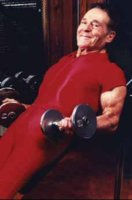
very true... take a look at the pics... two good examples of the long term side effects of bodybuilding.
i think jack lalanne is almost 90yrs old. zane is in his 70's.
Attachments


machine528
Member
Im 27 and i have not experienced any decrease in metabolism, im stronger than ive ever been, im faster and my recovery from workouts is the same as it was when i was 18.

Al Shades
Member
Males hit their athletic prime between 26-30, I'd say. They hit their strength prime long after 30.
There is maybe one 18-21 year old in a million who can reach the muscularity of a fully grown, adult male of 26 years or more. And that's with anabolics. A young Arnold, perhaps.
Nobody who trains consistently looks the same in their late 20's as they did when they were 20. In fact, this is true regardless of whether or not a person even trains. Males continue to gain weight and muscle mass until their early 30's, at least. There have been thousands of athletes and celebrities who started out as skinny 20 year olds and grew into full size mature adults. The examples are too numerous to list. The counter examples can be listed on one hand.
I have no idea where the idea came from that 18-20 is the "peak age" for athletes. It's completely, utterly, ludicrous. The only advantage that HS kids have is that they haven't accumulated as many injuries and they have (arguably) less stress in their lives. In every other way, they are inferior to older males.
Injuries aren't a prerequisite for getting older and stress can be managed. When you control for all other factors, athletic 30 year olds dominate athletic 20 year olds in every which way.
Otherwise, construction yards and other manual labor jobs would be filled with HS kids, instead of grizzly 35-50 year old guys! Haha - like that's ever going to happen.
I'm 20, btw.
There is maybe one 18-21 year old in a million who can reach the muscularity of a fully grown, adult male of 26 years or more. And that's with anabolics. A young Arnold, perhaps.
Nobody who trains consistently looks the same in their late 20's as they did when they were 20. In fact, this is true regardless of whether or not a person even trains. Males continue to gain weight and muscle mass until their early 30's, at least. There have been thousands of athletes and celebrities who started out as skinny 20 year olds and grew into full size mature adults. The examples are too numerous to list. The counter examples can be listed on one hand.
I have no idea where the idea came from that 18-20 is the "peak age" for athletes. It's completely, utterly, ludicrous. The only advantage that HS kids have is that they haven't accumulated as many injuries and they have (arguably) less stress in their lives. In every other way, they are inferior to older males.
Injuries aren't a prerequisite for getting older and stress can be managed. When you control for all other factors, athletic 30 year olds dominate athletic 20 year olds in every which way.
Otherwise, construction yards and other manual labor jobs would be filled with HS kids, instead of grizzly 35-50 year old guys! Haha - like that's ever going to happen.
I'm 20, btw.
VolcomX311
Legend
Males hit their athletic prime between 26-30, I'd say. They hit their strength prime long after 30.
There is maybe one 18-21 year old in a million who can reach the muscularity of a fully grown, adult male of 26 years or more. And that's with anabolics. A young Arnold, perhaps.
Nobody who trains consistently looks the same in their late 20's as they did when they were 20. In fact, this is true regardless of whether or not a person even trains. Males continue to gain weight and muscle mass until their early 30's, at least. There have been thousands of athletes and celebrities who started out as skinny 20 year olds and grew into full size mature adults. The examples are too numerous to list. The counter examples can be listed on one hand.
I have no idea where the idea came from that 18-20 is the "peak age" for athletes. It's completely, utterly, ludicrous. The only advantage that HS kids have is that they haven't accumulated as many injuries and they have (arguably) less stress in their lives. In every other way, they are inferior to older males.
Injuries aren't a prerequisite for getting older and stress can be managed. When you control for all other factors, athletic 30 year olds dominate athletic 20 year olds in every which way.
Otherwise, construction yards and other manual labor jobs would be filled with HS kids, instead of grizzly 35-50 year old guys! Haha - like that's ever going to happen.
I'm 20, btw.
The question wasn't really about how age effects your athleticism, I think it was more directed toward internal, biological, endocrinological and physiological changes due to age.
I'm not really critiquing your response or anything, but I'm not sure anyone mentioned that athletes peaked at 18-20. An athletic peak vs morphological changes as a result of age are two different concepts. One has to do with skill and talent, which depending on the sport can peak well into your 40's or 50's, like golf, but something like football is more like 25.
The idea of your body physically peaking, in terms of most consistent high elevation of testosterone, HGH and elevated metabolism has to do with puberty. Your body is in a state of growth, muscle development, bone development, breaking down calories to sustain such growth...etc These effects go on without you deciding to lift weights or having to do anything active. Following puberty, for the average sedentary person, all these effects will severely decrease because you're no longer growing. TRUE, it doesn't necessarily mean right after high school you instantly start going downhill. Your lifestyle will effect everything I just mentioned and you can definitely continue to excel in Test, HGH, Metab, Size, Strength all that. That's why High School Seniors are allowed to enter Pro Basketball, but not Football players, because the football players need those extra years in college to develop their bodies even bigger and stronger or they'd get killed in the NFL but all the fully developed monsters. HOWEVER, for the average "sedentary" person, who's not involved in resistance training, sports or any kind of activity to maintain or continue to augment their test, HGH, metab, 90% of the time they were much leaner, faster, and more muscular (maybe not "bigger" because size will come with fat) in their high school years, particularly their senior year when pubecent effects are at their peak.
This is why some high school kids can eat fast food 3 times a day and stay lean, but that same diet starts to build a nice One Pack following their puberty years due to the lack of free elevated metab because the body isn't demanding calories for growth anymore.
Side Note: I know some people can drink grissle shakes their whole life yet still pose for the cover of Men's Fitness, but those are much less common, (genetically blessed bastards) which is why America is 70% obese, most of us don't have the ability to get a six pack through bacon and chilli cheese fries (except for when we were in high school) :hot:
VolcomX311
Legend
I don't think that 70% of Americans are actually obese. Those figures are based off of the BMI which is ridiculously inaccurate. According to BMI I am obese at 13% bodyfat.
Otherwise great posts.
I was exaggerating, but I agree, the BMI's equation's are based on Age, Height, Gender & "bodymass," and determines where you should be by a general standard of those components. The flaw here of course is that it doesn't account for muscle mass, simply body mass. My BMI has me at 33% bodyfat (anything above 30 is obese) due to my age, height & bodymass (and I'm at 17% bodyfat.) Even the BIA, bioelectric impedence analysis can be corrupted by how much water is in your system "at the time of the test." The most accurate form of bodyfat testing is underwater weighing, but second to that are good ol calipers.

EasyEJL
Never enough
I don't think that 70% of Americans are actually obese.
According to BMI I am obese at 13% bodyfat.
Have you gone to a mall lately fatboy?
VolcomX311
Legend
like now they say "50 is the new 40" for age, obese is now the new slightly overweight....
hahaha
Al Shades
Member
The question wasn't really about how age effects your athleticism, I think it was more directed toward internal, biological, endocrinological and physiological changes due to age.
I'm not really critiquing your response or anything, but I'm not sure anyone mentioned that athletes peaked at 18-20. An athletic peak vs morphological changes as a result of age are two different concepts. One has to do with skill and talent, which depending on the sport can peak well into your 40's or 50's, like golf, but something like football is more like 25.
The idea of your body physically peaking, in terms of most consistent high elevation of testosterone, HGH and elevated metabolism has to do with puberty. Your body is in a state of growth, muscle development, bone development, breaking down calories to sustain such growth...etc These effects go on without you deciding to lift weights or having to do anything active. Following puberty, for the average sedentary person, all these effects will severely decrease because you're no longer growing. TRUE, it doesn't necessarily mean right after high school you instantly start going downhill. Your lifestyle will effect everything I just mentioned and you can definitely continue to excel in Test, HGH, Metab, Size, Strength all that. That's why High School Seniors are allowed to enter Pro Basketball, but not Football players, because the football players need those extra years in college to develop their bodies even bigger and stronger or they'd get killed in the NFL but all the fully developed monsters. HOWEVER, for the average "sedentary" person, who's not involved in resistance training, sports or any kind of activity to maintain or continue to augment their test, HGH, metab, 90% of the time they were much leaner, faster, and more muscular (maybe not "bigger" because size will come with fat) in their high school years, particularly their senior year when pubecent effects are at their peak.
This is why some high school kids can eat fast food 3 times a day and stay lean, but that same diet starts to build a nice One Pack following their puberty years due to the lack of free elevated metab because the body isn't demanding calories for growth anymore.
Side Note: I know some people can drink grissle shakes their whole life yet still pose for the cover of Men's Fitness, but those are much less common, (genetically blessed bastards) which is why America is 70% obese, most of us don't have the ability to get a six pack through bacon and chilli cheese fries (except for when we were in high school) :hot:
Yes - physiologically, everything is at it's peak from 17-20, as you pointed out.
But having high test doesn't necessarily mean someone is strong, muscular, fast, athletic, etc...
It takes time and effort for those hormones to act on the body to produce morphological changes.
While a 15 year old boy might have higher T levels than a 50 year old man, what 15 year old in the world could match a 50 year old in size or strength? None - you see my point. Muscle maturity and neurological efficiency come with age and years of activity-specific training. Pretty much every athletic 25-26 year old I've seen is bigger/stronger than the 19-20 year olds I've seen. Would you agree or have you observed differently?
My perspective is limited, of course, being that I'm only 20. However, I see myself just entering my full, adult stage of physical maturity. By the time I'm 25, I fully expect to be 1) taller, 2) more muscular, 3) stronger, and better all-around, provided I maintain my training. People mature at different rates as well, obviously. I think I started a bit later than others in my grade. There certainly are individuals who are monsters by 18 - we've all seen them.

DBinMD
Member
The down side:
As TripDog said, the hair moves. That’s the biggest change for me. The barber spends as much time as he always had just different places. I’m a little slower (outside the gym), but maybe because that because I don’t really give a **** most of the time like I used to. Memory is worse but never a strong point for me anyway.
The rest:
Slower recovery is a myth (at least for me).
Workouts are as good as they ever were, maybe better. Maybe experience has compensated for any physical losses. I feel I can saw this because 7 years ago (at 46) I busted both quad tendons and had to pretty much start over; it was 6 weeks before I was allowed out of bed. However, I found when I started I could train full upper body 3 times a week. Spend an hour in therapy and go lift upper body for another 2 hours. As the weights progressed my recovery times became slower until the point I could only train a body part once a week. This spring I had a PR of 520 x 3 on my deadlift w/o any DS/PH’s (not that I haven’t ever done so).
What I’m saying is you may simply need more recovery time because your workouts are becoming more intense.
DB
As TripDog said, the hair moves. That’s the biggest change for me. The barber spends as much time as he always had just different places. I’m a little slower (outside the gym), but maybe because that because I don’t really give a **** most of the time like I used to. Memory is worse but never a strong point for me anyway.
The rest:
Slower recovery is a myth (at least for me).
Workouts are as good as they ever were, maybe better. Maybe experience has compensated for any physical losses. I feel I can saw this because 7 years ago (at 46) I busted both quad tendons and had to pretty much start over; it was 6 weeks before I was allowed out of bed. However, I found when I started I could train full upper body 3 times a week. Spend an hour in therapy and go lift upper body for another 2 hours. As the weights progressed my recovery times became slower until the point I could only train a body part once a week. This spring I had a PR of 520 x 3 on my deadlift w/o any DS/PH’s (not that I haven’t ever done so).
What I’m saying is you may simply need more recovery time because your workouts are becoming more intense.
DB
VolcomX311
Legend
Yes - physiologically, everything is at it's peak from 17-20, as you pointed out.
But having high test doesn't necessarily mean someone is strong, muscular, fast, athletic, etc...
It takes time and effort for those hormones to act on the body to produce morphological changes.
While a 15 year old boy might have higher T levels than a 50 year old man, what 15 year old in the world could match a 50 year old in size or strength? None - you see my point. Muscle maturity and neurological efficiency come with age and years of activity-specific training. Pretty much every athletic 25-26 year old I've seen is bigger/stronger than the 19-20 year olds I've seen. Would you agree or have you observed differently?
My perspective is limited, of course, being that I'm only 20. However, I see myself just entering my full, adult stage of physical maturity. By the time I'm 25, I fully expect to be 1) taller, 2) more muscular, 3) stronger, and better all-around, provided I maintain my training. People mature at different rates as well, obviously. I think I started a bit later than others in my grade. There certainly are individuals who are monsters by 18 - we've all seen them.
My whole point was that for the "AVERAGE SEDENTARY" person, all these effects start to decline. I thought I was pretty clear about active people being able to continue to grow bigger and stronger as long as they remain active, which was my whole point about high schoolers not being allowed to go straight into the NFL, because the NFL requires the athlete's bodies to reach a much stronger level of size and strength through their athletic college years.
Anyone who continues to workout will FAR OUTSIZE their high school years, cumulative muscle, muscle maturity, increased mechanism of adaption, I don't think you're understanding my point.
I think your definition of a physical peak is "the best you can look or the best you can perform athletically," which I 200% agree with you, in ACTIVE people, like a lifestyle of bodybuilding or athletics, can reach well into the 30's. My definition for a physical in the "CONTEXT OF THIS THREAD," is the bodies internal mechanisms. Natural elevated testosterone, naturally elevated HGH and elevated metabolism. Just because these effects have decreased doesn't mean you can't continue to get bigger, stronger, faster. That's not my point. Biological reality is, following puberty all these effects decline, because our bodies are not in a growth phase, outside of intentionally doing so with weight lifting. Even so, muscle hypertrophy doesn't make you taller. It can make your bones' denser to a certain extent with axial skeleton, weight bearing exercises, but you're not getting any taller because of it.
So to make things clear, I'm not arguing we are peaked at 18-20 in terms of strength, size, speed or athleticism. We peak following puberty in the sense that our natural, unprovoked mechanism of growth has STOPPED. You don't get taller by lifting weights or shorter if you don't.
I know what you're saying that having high test doesn't make you peak, but you don't have to do anything during your pubecent years and you'll still grow taller AND stronger without external stimulation. Following puberty, if you're sedentary, you will not continue to get naturally stronger, as you would in your pubecent years. Freshmen don't lift to get to the size they are as seniors, it just naturally happens because of the "natural," unprovoked excretion of test and hgh in their system is at their peak.
I suppose I should have clarified my explanation of a peak, in the "context of this thread," peaking had to due with internal biological peak, whereas you were making a point for an external physical peak and we're on the same page that an external physical peak is definitely not reached in high school in terms of ACTIVE PEOPLE.
You're 20, and as long as you remain active in resistance training, you'll continue to get stronger, bigger, harder, denser well into your 30's. If you decided to stop being active. You'll continue to accrue bodymass, but primarily in the form of bodyfat (for the most part, there are always exceptions). That would be the case for your definition of a physical peak. We're good on that.
But I believe in the context of this thread, "25 and older" was addressing more so with internal biological changes.