LakeMountD
Doctor Science
Testosterone, dihydrotestosterone, trenbolone acetate, and zeranol alter the synthesis of cortisol in bovine adrenocortical cells
W. K. Isaacson, S. J. Jones and R. J. Krueger
Department of Animal Science, University of Nebraska, Lincoln 68583-0908.
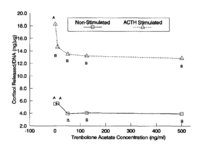
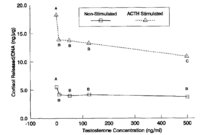
The objective of this study was to examine the effect of anabolic steroids (testosterone, T; dihydrotestosterone, D; trenbolone acetate, B; and zeranol, Z) on cortisol synthesis by cultured bovine adrenocortical cells. Adrenal glands were obtained from slaughter-aged steers (n = 4). Cortical cells were isolated and their steroidogenic capacity was examined. They were plated in multiwell culture plates. At confluence, cells were treated with T, D, B, or Z at 0, 10, 50, 125, or 500 ng/mL (eight wells per treatment). Twenty-four hours after treatment, one-half of each treatment concentration was stimulated with 10(-9) M ACTH. After 8 h of incubation, cortisol concentration in the media was measured using RIA. Cortical cells were removed from the plates using 1 mM EDTA and analyzed for DNA content. Data were subjected to rank transformation and analyzed by randomized complete block design. Adrenocorticotropic hormone stimulated (P < .01) the release of cortisol by more than threefold. Cortisol synthesis was lower (P < .05) in the presence of T, D, and B. Testosterone caused a greater (P < .05) suppression in cortisol production at 50 and 125 ng/mL than did D. The suppression of cortisol synthesis did not differ between B and T or between B and D. Cortisol synthesis was lowered (P < .05) by the presence of T, D, and B in both ACTH-stimulated and nonstimulated cells but was only suppressed in ACTH-stimulated cells of Z-treated cells.
W. K. Isaacson, S. J. Jones and R. J. Krueger
Department of Animal Science, University of Nebraska, Lincoln 68583-0908.
The objective of this study was to examine the effect of anabolic steroids (testosterone, T; dihydrotestosterone, D; trenbolone acetate, B; and zeranol, Z) on cortisol synthesis by cultured bovine adrenocortical cells. Adrenal glands were obtained from slaughter-aged steers (n = 4). Cortical cells were isolated and their steroidogenic capacity was examined. They were plated in multiwell culture plates. At confluence, cells were treated with T, D, B, or Z at 0, 10, 50, 125, or 500 ng/mL (eight wells per treatment). Twenty-four hours after treatment, one-half of each treatment concentration was stimulated with 10(-9) M ACTH. After 8 h of incubation, cortisol concentration in the media was measured using RIA. Cortical cells were removed from the plates using 1 mM EDTA and analyzed for DNA content. Data were subjected to rank transformation and analyzed by randomized complete block design. Adrenocorticotropic hormone stimulated (P < .01) the release of cortisol by more than threefold. Cortisol synthesis was lower (P < .05) in the presence of T, D, and B. Testosterone caused a greater (P < .05) suppression in cortisol production at 50 and 125 ng/mL than did D. The suppression of cortisol synthesis did not differ between B and T or between B and D. Cortisol synthesis was lowered (P < .05) by the presence of T, D, and B in both ACTH-stimulated and nonstimulated cells but was only suppressed in ACTH-stimulated cells of Z-treated cells.