niners4reggie
Well-known member
I got a fever, and the only prescription is more cowbell! And PF3.
Hope you feel better soon.
Gotta have more cowbell! When you put PF3 in the mix BAM! That's a como for greatness!!

I got a fever, and the only prescription is more cowbell! And PF3.
Hope you feel better soon.
Got my stash (much thx) earlier in the week. Yesterday mixed Grape and some leucine but unfortunately no scooper in my leucine, did the old finger dive but nothing. I mixed with with a shaker ball and as others stated there is alot of foam and also alot of white bubbles stuck to the sides when done.
Taste was good. Planned on hitting it hard today but woke up queasy and fever...stay tuned.

Id say that the stool is softer and instead of good solid go its two at a longer pace... If that makes sense. And gotta have a couple extra wipes, now my TP cost is going up. Dang the things we must sacrifice for a better body.
On another note I state in my log that I believe the extreme lightheaded, disorientation and violent throwing up was a Combe of what I was taking. I had double dose of a preworkout and I was also using a PH. I have not experienced any sides since. Now I am just looking for growth.

Thanks guys, is there supposed to be a scooper in the Leucine?

No kidding. I'm pretty sure I tore my esophagus last time I puked. It felt like a heart attack. Now I'm scared to puke again. Doing leg lifts with 120 lbs for reps as well as sit ups probably make me more likely to tear something.puking is rough
So then you agree that MAN is guilty of false advertising...i didnt suggest anything; i flat out agreed with you that the specific peptides we are talking about dont just end up in the bloodstream intact

Got my pf3/f-leucine today, yay!
....So then you agree that MAN is guilty of false advertising
no. i do not agree to that. ive stated what i know about peptides of that size and how theyre broken down before entering the bloodstream. nowhere has man said the peptides would be absorbed entirely intact into the bloodstream
just a fair warning before reading this >> I've had head cold night & have barely slept.. so if this is a bit choppy forgive me.
I'll answer your questions in the numerical order they were answered
1. There is zero milk in Serum Protein Isolate, nor is it derived from milk. It is derived from bovine plasma (sourcing is key here).
2. Your correct, for some reason the published amounts diagram loaded on the 1%er landing page sale, but not the public page. I just uploaded it again >> now its showing, check it out under Perfect Ratio of Revolutionary Building Blocks Chart: Invalid Link Removed
3. I have an extensive background in carbohydrates, this is why I get so excited about the molecular weight. Here is a basic bro-test: take a scoop of another powdered BV product & put it in the bottle of water >> it most likely will just sit on top of the water, but with PF3 it collects into a heavy mass-like structure & drops to the bottom of the bottle. This shows its capability of pulling nutrients to the bottom of your stomach to allow faster absorption. I know this is a bro-test but it is extremely effective in showing if something is capable of super-shuttling nutrients (of course knowing the actual dalton weight & measuring the molecular size is key for this too ).
The real absorption rate of the active ingredients in PF3 comes from the high high dose of the Globulin Complex (IgG, IgM, IgE, IgD, IgA) which are powerful anti-bodies that stop gut inflammation allowing for aborption of the bio-active ingredients & peptide protein fractions (making up the 75% Bio-Active Value).
So to simply answer your question, the engineered molecular size & structure help it pass through your small intestines fast then acts the opposite once it reaches your blood stream, due to its large size it slows down flow & allows for your body to absorb nutrients with it more efficiently (from my understanding up to 16x more - from the words of our chief scientist) >> but the real focus here should be the 58% Globulin Complex that stops gut inflammation allowing for the ingredients to actually be absorbed & not destroyed through ingestion.

That is exactly what this says:nowhere has man said the peptides would be absorbed entirely intact into the bloodstream

well, i would take "assimulation" here to mean assimulation after it is digested, with the molecular size being described as desirable in so far as it is slowly taken in; my interpretation of that is supported by the following sentences on that ad which reference the slowness of the large dalton protein being taken in (slowly once it is broken down i presume). i suppose if the ad were written like a legal document it would clear up any possibility for misunderstanding, but then who would read it? the fact is, semantically speaking, i see scientific studies all the time that talk about how a slower digesting protein stays in the bloodstream longer, when in fact it doesnt stay any longer but rather aminos are seen present in the stream after a longer period of time due to the fact that they are being released at a slower and more steady rate. anyway, i think the bigger idea here is the effects on the GI tract itself.That is exactly what this says:"Pure PF3 is engineered with an extremely high molecular weight. This precise molecular size is not too big and not too small but rather just the perfect size for assimilation by the body."Assimilation happens after digestion. That sentence is saying the high molecular weight molecule is itself assimilated. It wouldn't make sense any other way you try to spin it.
Why ask questions when your mind is already made up, these topics of concern have been answered over and over during "the bashing phase" of the release of this product not to mention there's another thread dedicated to these questions....
Lets keep this thread clean for the members who have real interest and are being open minded while the logs are active.....
Thanks
yeah, there's supposed to be one. i used a fork to locate mine; it was at the bottomThanks guys, is there supposed to be a scooper in the Leucine?

yeah, there's supposed to be one. i used a fork to locate mine; it was at the bottom

Used my finger and a fork..nothing there...onward and upward. No time to quibble
yeah, if you dont have one in either, i would say the scoop is about equal to a teaspoon; i can get you a more precise comparison if necessaryUsed my finger and a fork..nothing there...onward and upward. No time to quibble

Why ask questions when your mind is already made up, these topics of concern have been answered over and over during "the bashing phase" of the release of this product not to mention there's another thread dedicated to these questions....
Lets keep this thread clean for the members who have real interest and are being open minded while the logs are active.....
Thanks
You don't want potential consumers to ask legitimate questions about your product?
Of course I/we do. "The science" started a Q&A thread specifically for the questions/concerns being asked.....
Where's the Q&A thread?

Yeah, wouldn't mind a link - a site search of "PF3 Q&A" turned up nothing...
Maybe we'll get to see some of those "medical grade" effects that were seen in hospital usage.
Is this it?
Invalid Link Removed
I remember that thread, I did not recall it as being a Q&A thread though. I think this thread right here has more Q&A stuff and over all probably more informative?
Hey MAN reps, I'm rereading that thread right now and the second post, a user states 2 scoops was 10 grams of PF3. Did the scoop sizes change on the final product?
After reading that thread, makes me wonder if my doses of pre, intra and post-workout are too close together......
Yeah, wouldn't mind a link - a site search of "PF3 Q&A" turned up nothing...
Maybe we'll get to see some of those "medical grade" effects that were seen in hospital usage.

are you denying this is used in the medical field? what information do you have to support your charge that false claims are being made? I posted results of a double-blind study on this thread. if a double-blind study warranting its use as an effective "medical food" (so deemed) isn't good enough for you, then im not going to be able to provide you with whatever kind of assurance youre looking for in a supplement
are you denying this is used in the medical field? what information do you have to support your charge that false claims are being made? I posted results of a double-blind study on this thread. if a double-blind study warranting its use as an effective "medical food" (so deemed) isn't good enough for you, then im not going to be able to provide you with whatever kind of assurance youre looking for in a supplement
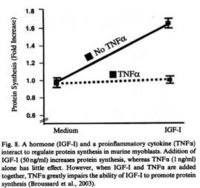
i stuck the results up of a study done for IBS-D, verifying its efficacy against inflammation, very recently within the last few pages. the study was on their promo page, along with others done for some kind of HIV condition and another for high cholesterol, all of which the stuff has beneficial effects on.; if that company wants me to promote their stuff beyond that by linking their promo page, they would have to pay me some of those big pharma buck$. just to clarify: are you referring to the graph concerning, not "tgf-1," but IGF-1?I asked to see the hospital data and was ignored. If you have posted it in this thread, maybe post another link to it? There are 60 pages here and I'm not wading through all of them. Or perhaps clarify which thread is the "Q&A" one mentioned earlier, if you'd prefer inquiries be directed elsewhere.All I want is to see the data and evaluate your claims with the actual science that is associated with your product. So far all I've seen is 1 graph in the write-up from mouse fibroblast TGF-1 levels in vitro, which is not convincing at all and only tangentially relevant.
i stuck the results up of a study done for IBS-D, verifying its efficacy against inflammation, very recently within the last few pages. the study was on their promo page, along with others done for some kind of HIV condition and another for high cholesterol, all of which the stuff has beneficial effects on.; if that company wants me to promote their stuff beyond that by linking their promo page, they would have to pay me some of those big pharma buck$. just to clarify: are you referring to the graph concerning, not "tgf-1," but IGF-1?
bb. misfit: let me know if you are more or less able to determine if this is happening from your testing as, depending on the kind of increase in motility we are talkiing about, it may be advisable to reduce dosage to the one scoop a day or drink more water ect until things normalize. let me know also of any changes from that status with your bowels as the days go by. Immunoglobins, lactoferrin ect have tremendous anti-pathogenic properties. the studies ive seen on the main ingredient in pure Pf3 in pharma on ibs-d (ibs that is predominantly diarrhea) would not shed any light as to any increase in bowel motility at the start (when pathogens were being removed) as the subject had pre-existing chronic diarrhea, but by the end of the study, many had REDUCED frequency: IBS-D Randomized, double- blind, placebo- controlled, single site, 6 week study N=66 patients diagnosed with IBS-D Placebo, "***" 5 g/day or "***" 10 g/day10 g/d "***"group had a reduction in days with loose stools (p = 0.011), abdominal pain (p = 0.008), urgency (p = 0.050), bloating (p = 0.044); flatulence (p = 0.003); and any symptom (p = 0.009). 5 g/day "***" group experienced reductions in days with flatulence (p = 0.018), incomplete evacuation (p = 0.020), and any symptom (p = 0.010).
IF this is the post you are referring to, this is not an acceptable reference - this is barely readable. Can we see the actual study please?
This is starting to reach ludicrous speed.
im not sure what part you are barely able to read, but maybe this will help: the study involved the main component of PF3. *betaine hcl was not present as an additional ingredient in the study. in a Randomized, double- blind, placebo- controlled, single site, 6 week study N=66 patients diagnosed with IBS-D were given a Placebo, 5 g/day of (the same compound in PF3) or 10 g/day10 g/d of (the same compound found in pf3) . the 10g/day group had a reduction in days with loose stools (p = 0.011), abdominal pain (p = 0.008), urgency (p = 0.050), bloating (p = 0.044); flatulence (p = 0.003); and any symptom (p = 0.009). the 5 g/day group experienced reductions in days with flatulence (p = 0.018), incomplete evacuation (p = 0.020), and any symptom (p = 0.010).
how can you say the Randomized, double- blind, placebo- controlled, single site study, with which a drug company is authorized to provide this stuff in hospitals, needs validating? the study addresses my claim (that was in question) referring to medical usage of the main substance in pf3. this and other such studies exist. that is the point i was asked about AND NOT anything pertaining to a comparison between whey and pf3. i do not provide links here to any site that can be viewed as a competitor with AM, as per their rules; this particular site does not provide the reference you requested, though it does have more details about the study..Again, this is not an acceptable reference. This is a reference: Tipton KD, Elliott TA, Cree MG, Wolf SE, Sanford AP, Wolfe RR. Ingestion of casein and whey proteins result in muscle anabolism after resistance exercise. Med Sci Sports Exerc 2004;36(12):2073-2081.It includes all relevant metadata. Your paragraphs do not. Nor do they include the methods and reagents section, which are imperative to the validity of the study - simply posting results as p values without context is misleading. Were the controls sufficient to cover all possible alternative explanations? We don't know from what you've posted.For example, it doesn't seem any of the experimental groups were given just plain old whey - without this control, you can't make the claim that PF3 is superior to whey, because there is no data that says PF3 has superior effects, because control was placebo and no other controls given. If that control is in there, I very much want to see it, because THAT is the interesting result - the difference between PF3 and whey.Can you provide the ACTUAL reference from which these data you have been kind enough to provide were taken?I'm going to wade through some of the studies in the bibliography, but really, what I'm asking for is quite simple and I don't understand why I have had to repeat so much. All I want is the one reference from which you are taking your numbers. That's all. Shouldn't be that hard to say "Oh yeah, that data's in So-and-so, Nature, 2009."
people who exercize generate inflammation; repeat sales will determine how badly people need pf3's anti-inflammatory and other benefits. there are beta-testers right now who never thought of themselves as having a problem with inflammation that are benefiting strongly from pf3 , so i wouldnt discourage anyone from trying it and i wouldnt downplay the systemic effects inflammation can have. pf3 has a different profile from colostrum; whereas colostrum has proline rich peptides which is awesome, it has some pro-inflammatory contents that are unique to it. with regards to the ingredients they have in common, pf3's got more of them per serving than your typical serving of alot of colostrum products out there. the fact is, alot of people dont know about colostrums great benefits, even though its been around for a long time, so i think its always a positive thing to make the beneficial properties of anything known.After a quick scanning of the abstracts, here's what I think: There is the possibility this has anti-inflammatory properties on the gut, since there is evidence that similar products do likewise in multiple model systems, though sample size was preliminary really. Beyond that, it's just pretty much colostrum, which has been around since the nineties...I say if you got gut issues, take it, can't hurt; but I wouldn't ditch my plain ole whey. Plasma proteins out performed "Extruded Soy" for lean body mass gain, but only in equivalent doses, which is understandable given the higher bioavailability of bovine protein. That's like comparing whey and soy. I didn't see a comparison of plasma to whey though in regards to weight gain. Whey did do worse at reducing inflammation, but it was in the presence of a diarrhea inducing bacteria. So as I said, if you got gut issues take it, but it can't replace the sheer volume of nutrients of traditional whey unless you were to take it in equivalent doses. At least that's what I see from a quick review of the abstracts.
how can you say the Randomized, double- blind, placebo- controlled, single site study, with which a drug company is authorized to provide this stuff in hospitals, needs validating? the study addresses my claim (that was in question) referring to medical usage of the main substance in pf3. this and other such studies exist. that is the point i was asked about AND NOT anything pertaining to a comparison between whey and pf3. i do not provide links here to any site that can be viewed as a competitor with AM, as per their rules; this particular site does not provide the reference you requested, though it does have more details about the study..
Because you're not letting me determine the validity of the study. You're feeding me the data without showing me the study. If you have no context, no methods, how can you be sure the experiments were performed properly? Controlled properly? Results can be misinterpreted or faked - checking the methods and the figures allows for validation of the responsible conduct of science. After all, if PF3 performs no different from whey, why take it? That's the importance of that control, which was not included.
If it would be linking to a site that could be construed as competitor to AM, I'm curious, is this "study" even peer reviewed? Or is it simply proprietary data from this "drug company/"
But I'm done. It took me sitting down and wading through 30+ papers myself when I should been able to ask a simple question and receive a simple forthright answer from MAN reps. But that was not the case. I was told to essentially figure it out for myself. So I did.
And no it's not colostrum. that's why I said "basically like colostrum" - it's an immuno-peptide enriched protein isolate, similar in immunological composition to the colostrum and sprayed-freeze dried pigs blood used in your references.
Did those colostrum studies use colostrum or are you referring to the colostrinin study (colostrinin is basically strictly the PRPs from colostrum). The colostrinin study is where I've seen the results where there was tangible positive effects on auto-immune, Alzheimer, and allergies, but colostrinin is not colostrum, it's extracted from colostrum but it's not colostrum.