BIGGER, FASTER, STRONGER: Snag's Recipe for a [NATURAL] Recomp, Competition Style!

That is the one glaring limitation: This program really only works when training in the morning, almost complete or near complete fasted-state. Once you take in your carbohydrate-rich diet, the oxidative substrate is altered and your body will turn to muscle glycogen for energy provision.
 
Question: How can I apply this when I w/o late afternoon? I can't w/o in the morning. How much time would qualify as a fasted state before w/o?

Try to keep your carbs as low as possible, with primarily pro/fat meals. Then have your carb meals PWO, and maybe one more, leading up to your carb cutoffs if you use them.

This is the best way to maintain some sort of CHO fasted state imo, I'm sure the guys here can offer some other ideas.

Is there any way you could get to the gym or some sort of cardio equipment early in the AM and still lift in the afternoon?

I know I'm out of kilter with the conversation going on in the thread right now, but wanted to respond to this..

I'm not saying ATG form is the 'be-all/end-all', simply stating that this works well for me and is my preferred form. I utilize just below parallel form as well; I bust out box squats every once in awhile.. I'm just saying, things have to be taken in context. There is a HUUUGE difference between 300lbs. ATG and 300lbs. with a 6" ROM not even coming close to parallel..


Aaaaaaamen. I hate when my roommates [all football players] try to compare squats with me, or anyone for that matter simply because I know 95% of people that squat or talk to me about squatting don't go nearly as low as me. So when I hit 365 x 3 ATG, they think I'm a pussy and it's not worth the frustration. So I usually just try switching up the topic.
 
Sup Snag....just wanted to say I squatted 600lbs, and I almost hit parallel! ;)


Haha, sup brother? Actually just on my way out to hit legs/back, hopefully my lower back is recovered enough for some hack squats.

Well that's more than me my brother.. :box:

Getchya some leg work in man!
 
Mullet, could you employ a really low-glycemic carb like palatinose or would you just go totally without em' during the 'fasted state'?
 
Gonna rant here for a minute.. :rant:

A lot of things piss me off. As I've gotten older, I've learned to lighten up a bit, not sweat the small stuff.. but some things still aggravate the living hell outta me..

(Maybe this is the Prime aggression kicking in full-bore here..)

Had a couple of discussions about my squats with a few guys.. When I post my squat #'s, this is me going ass-to-grass; that is my preferred form. I don't have a rack that stops me prior to getting to parallel; to save me if I can't handle the weight. I have no spotter. If I can't get that sh!t back up, then it's squashing me, pure & simple. I don't use wraps; I don't use machines. It's just me & the weights, going ATG..

So then I get some smartass comment. Then I see some vids of these guys, going like not even close to parallel.. and walking around talking about their 400 or 450lb. squats. That's done on a rack. With a ROM of like 6".

:aargh: This absolutely kills me, and is the exact reason why I don't like posting my weights. Without knowing the form someone takes, these #'s are irrelevant.

I know my weaknesses, and legs are not my strong point. But it pisses me off that ppl pass off the credibility of some #'s, and then someone (like a noob or something) is just in awe of a certain individual because of these inflated #'s. Like they know what they're talking about, because they squat x amount of weight; while this guy here (insert me) must not know sh!t, cuz he's weak..

Ahhhhh..I know, I know - silly to let such things get to ya. But I'm just venting.

Fact is, some #'s ppl post are just ludicrous. (And I'm not referring to anybody in this thread btw). There are some strong dudes running around; TG is a beast. Vol is a strong dude. Viking is crazy strong. Tommy Jeffers has beastly leg strength. Doug Miller is on another planet. Watch these guys, check out their vids -- this is true strength, with proper form..

And random note: but who the hell really cares what someone can do on leg extensions anyway? Great, you're wrecking your knees..you really think doing 225 on leg extensions is an accomplishment? You really think that is what is gonna develop your quads???

These "irrelevant" issues urk me all the time. I see a lot of people cheating their bench, more then their squat. It kills me as well, sometimes it bothers me more then other times.

There is this legitimately muscular guy at our gym, but the way he uses the free weight loaded triceps machine... you can hear him bouncing the weight from across the room, the weights actually violently rattle from how hard he bounces that thing and of course it's loaded to the brim. I hate that stuff.
 
Mullet, could you employ a really low-glycemic carb like palatinose or would you just go totally without em' during the 'fasted state'?

Totally without them. The point is to force your body to utilize its own FFA/triglyceride stores as the primary source of energy. When you wake up in the morning, plasma FFAs are ample due to nocturnal lipolysis; when you ingest carbohydrates in the morning, these hydrolyzed fatty acids return and accumulate.

I am no expert or guru, and there are many ways to skin a cat, so to speak. However, in my opinion, this fasted training method should be done in the morning, after a long fast.
 
Totally without them. The point is to force your body to utilize its own FFA/triglyceride stores as the primary source of energy. When you wake up in the morning, plasma FFAs are ample due to nocturnal lipolysis; when you ingest carbohydrates in the morning, these hydrolyzed fatty acids return and accumulate.

I am no expert or guru, and there are many ways to skin a cat, so to speak. However, in my opinion, this fasted training method should be done in the morning, after a long fast.

What about my idea of ingesting Pslin 4 hours before a workout with carbs would this be sufficient time to enduce a fasted state.
 
Totally without them. The point is to force your body to utilize its own FFA/triglyceride stores as the primary source of energy. When you wake up in the morning, plasma FFAs are ample due to nocturnal lipolysis; when you ingest carbohydrates in the morning, these hydrolyzed fatty acids return and accumulate.

I am no expert or guru, and there are many ways to skin a cat, so to speak. However, in my opinion, this fasted training method should be done in the morning, after a long fast.

Well obvious that I am in agreement with this stance.

Any form of carb - irrespective of how fast it is absorbed - will disrupt this process.
 
Totally without them. The point is to force your body to utilize its own FFA/triglyceride stores as the primary source of energy. When you wake up in the morning, plasma FFAs are ample due to nocturnal lipolysis; when you ingest carbohydrates in the morning, these hydrolyzed fatty acids return and accumulate.

I am no expert or guru, and there are many ways to skin a cat, so to speak. However, in my opinion, this fasted training method should be done in the morning, after a long fast.
Excellent Mullet. I am definitely going to be trying this out. Maybe morning pilates, abs, and jumping jacks or something... Thanks.
 
I am no expert or guru, and there are many ways to skin a cat, so to speak. However, in my opinion, this fasted training method should be done in the morning, after a long fast.

Mullet, you've got to quit being modest about this.. you have initiated a revolution! :afro:

Now, the only aspect in which I will disagree with your theory, is the little-to-no-carbs before bed the previous night part. I personally do not think this is an aspect that needs to be followed; in fact, if one is running keto dietary intake, and has that large 2x weekly pure carb meal for the last meal at night, I think this is the optimum format to run the following morning. It just makes intellectual sense to me..
 
Everyone one who's running a fasted state should temporarily put this on their avi :stick:

Invalid Link Removed
 
Now, the only aspect in which I will disagree with your theory, is the little-to-no-carbs before bed the previous night part. I personally do not think this is an aspect that needs to be followed; in fact, if one is running keto dietary intake, and has that large 2x weekly pure carb meal for the last meal at night, I think this is the optimum format to run the following morning. It just makes intellectual sense to me..

Fair enough. You know your body best! Intellectually, though, my reasoning was summated in this study:

Low-fat diet alters intramuscular substrates and reduces lipolysis and fat oxidation during exercise.

Coyle EF, Jeukendrup AE, Oseto MC, Hodgkinson BJ, Zderic TW.
Human Performance Laboratory, Department of Kinesiology and Health Education, University of Texas at Austin, Austin, TX 78712, USA. [email protected]as/edu

We determined whether a low-fat diet reduces intramuscular triglyceride (IMTG) concentration, whole body lipolyis, total fat oxidation, and calculated nonplasma fatty acid (FA) oxidation during exercise. Seven endurance-trained cyclists were studied over a 3-wk period during which time they exercised 2 h/day at 70% of maximum O2 uptake VO(2 max) and consumed approximately 4,400 kcal/day. During the 1st wk, their fat intake provided 32% of energy. During the 2nd and 3rd wk, they were randomly assigned to eat 2 or 22% of energy from fat (2%FAT or 22%FAT). Compared with 22%FAT, 2%FAT lowered IMTG concentration and raised muscle glycogen concentration at rest (P < 0.05). Metabolism was studied during 1 h of exercise at 67% VO(2 max) performed in the fasted state. 2%FAT resulted in a 27% reduction (P < 0.05) in total fat oxidation vs. 22%FAT without altering the stable isotopically determined rates of plasma free fatty acid or glucose disappearance. Therefore, 2%FAT reduced calculated nonplasma FA oxidation by 40% in association with a 19% reduction in whole body lipolysis while increasing calculated minimal muscle glycogen oxidation compared with 22%FAT (all P < 0.05). In summary, an extremely low fat (2% of energy) and high-carbohydrate diet lowers whole body lipolysis, total fat oxidation, and nonplasma FA oxidation during exercise in the fasted state in association with a reduced concentration of intramuscular triglyceride.

Physiologically, the ingestion of carbohydrates the preceding night will decrease whole body lipolysis and IMTG concentrations, necessarily reducing the amount of 'fuel' [so to speak] for the next morning. The ingestion of carbohydrates will also necessarily reduce the amount of FA oxidation; both intramuscularly and plasma! The ingestion of carbohydrates the night prior is actually counterintuitive to the physiological-concepts behind fasted training! As you can see, reductions of 19% in lipolysis and 40% in FA oxidation could hypothetically defeat the purpose of fasted training!

As displayed by the lack of alteration in the rate of disappearance, the total FA concentration available to be oxidized is attenuated due to the activation glycolytic pathway. The energy, strength and endurance derived from fasted training rests on one placing their body in a state of adherent nocturnal-lipolysis to sufficiently liberate WAT [white adipose tissue stores] to elevate plasma FFA concentrations to work in concert with the intramuscular triglyceride oxidation!
 
Low-fat diet alters intramuscular substrates and reduces lipolysis and fat oxidation during exercise.
Coyle EF, Jeukendrup AE, Oseto MC, Hodgkinson BJ, Zderic TW.
Human Performance Laboratory, Department of Kinesiology and Health Education, University of Texas at Austin, Austin, TX 78712, USA. [email protected]as/edu

We determined whether a low-fat diet reduces intramuscular triglyceride (IMTG) concentration, whole body lipolyis, total fat oxidation, and calculated nonplasma fatty acid (FA) oxidation during exercise. Seven endurance-trained cyclists were studied over a 3-wk period during which time they exercised 2 h/day at 70% of maximum O2 uptake VO(2 max) and consumed approximately 4,400 kcal/day. During the 1st wk, their fat intake provided 32% of energy. During the 2nd and 3rd wk, they were randomly assigned to eat 2 or 22% of energy from fat (2%FAT or 22%FAT). Compared with 22%FAT, 2%FAT lowered IMTG concentration and raised muscle glycogen concentration at rest (P < 0.05). Metabolism was studied during 1 h of exercise at 67% VO(2 max) performed in the fasted state. 2%FAT resulted in a 27% reduction (P < 0.05) in total fat oxidation vs. 22%FAT without altering the stable isotopically determined rates of plasma free fatty acid or glucose disappearance. Therefore, 2%FAT reduced calculated nonplasma FA oxidation by 40% in association with a 19% reduction in whole body lipolysis while increasing calculated minimal muscle glycogen oxidation compared with 22%FAT (all P < 0.05). In summary, an extremely low fat (2% of energy) and high-carbohydrate diet lowers whole body lipolysis, total fat oxidation, and nonplasma FA oxidation during exercise in the fasted state in association with a reduced concentration of intramuscular triglyceride.

While I won't argue with the science presented (..yeah, right, like I could win an argument with Mullet anyway.. :rolleyes:), I still feel there's more in play here. First, the study was done with hi-carb/low-fat diets. Now, this in itself will lead the body toward certain physiological processes, sure. When one is not on this particular dieatry intake, metabolic responses will not be the same..

For the purposes of fasted training (protocol you've laid out), the science is solid. I think the key is after sleep, upon rising.. this process works, independent of what diet one is on. In my example of carb-load prior to bed in keto, this serves the function of incurring thyroid production -- due to thyroid output slowing on carb-reduced keto diets. In this format, these carbs are not stored to body fat; in fact, this action - followed by reverting back to low-carb ingestion - induces continued lipolysis; therefore, I see no impedance in the lipolytic response to fasted-training the following morning. Even a moderate amount of carbs at the last meal, assuming the diet as a whole is not hugely skewed to carbs, and the fat content of same is at healthy intake levels - should not impact this process.

Anyway, bottom line bro - this process works. I've used it successfully and with notable results -- after large carb loads the previous night (with the intention of burning off those calories) in non-keto diet; after moderate carb ingestion w/ last meal; and with low-carb at last meal. I've seen & felt the impact in all three scenarios.

So, maybe what we've established here is this: do not use this method if you are routinely eating hi-carb/low-fat meals thruout the rest of the day -- because then, it will not work as well.. (and this particular diet lends itself to the process we call 'bulking' anyway, so why would you want to?)..
 
Really REALLY good info guys !! :thumbsup:
 
These "irrelevant" issues urk me all the time. I see a lot of people cheating their bench, more then their squat. It kills me as well, sometimes it bothers me more then other times.

There is this legitimately muscular guy at our gym, but the way he uses the free weight loaded triceps machine... you can hear him bouncing the weight from across the room, the weights actually violently rattle from how hard he bounces that thing and of course it's loaded to the brim. I hate that stuff.
I don't see why people let cheaters and liars bother them so much. If people cheat while lifting (bouncing, heaving, swaying, or incomplete reps), are they not in fact only cheating themselves??!! And people who lie about the weights they are using, who does that affect??! Only themselves. They are mainly lying to their own consciences. Poor infidels.
When people question me about my weights, as in disbelief, I reply, "You're right. I'm lying. I can only use an empty bar". :lol:
 
I don't see why people let cheaters and liars bother them so much. If people cheat while lifting (bouncing, heaving, swaying, or incomplete reps), are they not in fact only cheating themselves??!! And people who lie about the weights they are using, who does that affect??! Only themselves. They are mainly lying to their own consciences. Poor infidels.
When people question me about my weights, as in disbelief, I reply, "You're right. I'm lying. I can only use an empty bar". :lol:

:goodpost:

You're right TG. How miserable one must feel to have to constantly bolster their own ego & self-worth with exaggerations & falsehoods -- at the expense of having to go home, look at themselves in the mirror, and REALLY know what they're all about!!
 
:goodpost:

You're right TG. How miserable one must feel to have to constantly bolster their own ego & self-worth with exaggerations & falsehoods -- at the expense of having to go home, look at themselves in the mirror, and REALLY know what they're all about!!

Did someone say Boxmeman?
 
Some great posting in here fellas, nice job holding your own Snag :duel:

My lower back is shot, even hack squats just put way too much strain. Icing it now, I think this strain is going to require a week off, which might be a good idea anyway.

Whats everyone up to tonight?
 
(one hand on hip and the other pointing a finger swaying back and forth)
"Oh no you deedint'!!" :lol:

Someone's gotta catch me up to speed with this...all I remember is Box having a DTH log I used to stop by in. Did he have some insane e-stats? :thumbsup:
 
Some great posting in here fellas, nice job holding your own Snag :duel:

My lower back is shot, even hack squats just put way too much strain. Icing it now, I think this strain is going to require a week off, which might be a good idea anyway.

Whats everyone up to tonight?

3 more meals, going to my second job, and second session of cardio.

Nothing worse then a shot lower back. Mine has been shot for awhile, so I haven't done, and will not be able to do Dead lifts or Bent Over BB rows for many months ahead :nutkick:
 
Some great posting in here fellas, nice job holding your own Snag :duel:

My lower back is shot, even hack squats just put way too much strain. Icing it now, I think this strain is going to require a week off, which might be a good idea anyway.

Whats everyone up to tonight?

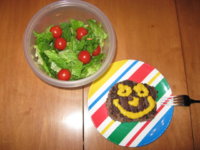
Just cooking dude.. :D

A lil' twist on an old fav..

8oz. 96% lean beef
4oz. Romaine salad w/tomatoes
1/2 TBS EVOO
1/2 TBS Olive Oil vinaigrette
1 TBS Balsmalmic Vinaigrette

Think this is my standard #5 meal for awhile. It's just too easy to make, and this particular spot is where I want to consume approximately 1/3 of my total fat intake for the day..
getting anal here fellas.. :p

A little smile for all my friends in AM.land! ;)
 

Attachments

  • IMG_2087.JPG
    IMG_2087.JPG
    121.2 KB · Views: 303
Now THAT's a Happy Meal brother!! :lol: And it looks easy and delicious. I'm about to sit down to a lean beef roast with onions, carrots, and sweet potatoes swimmin' all around it!! :food: Bon Appetit Snag.
 
Just cooking dude.. :D

A lil' twist on an old fav..

8oz. 96% lean beef
4oz. Romaine salad w/tomatoes
1/2 TBS EVOO
1/2 TBS Olive Oil vinaigrette
1 TBS Balsmalmic Vinaigrette

Think this is my standard #5 meal for awhile. It's just too easy to make, and this particular spot is where I want to consume approximately 1/3 of my total fat intake for the day..
getting anal here fellas.. :p

A little smile for all my friends in AM.land! ;)


that looks so yummy! I am really hungry right now!!!
 
I'm like Pavlov's dog everytime I go to this thread....salivating for food.
 
First, the study was done with hi-carb/low-fat diets. Now, this in itself will lead the body toward certain physiological processes, sure. When one is not on this particular dieatry intake, metabolic responses will not be the same..

They were, however, I believe you are missing a key component: The differing diets produced cumulative changes in pre-training glycogen content, lipid-binding gene mRNA expression, and IMTG storage which can be reproduced transiently as reflected by the data. I.e., the diet-induced alterations in fatty acid metabolism seen in the particular study you are quoting can be reproduced by [relatively] immediate glycogenesis! I explain more below.

For the purposes of fasted training (protocol you've laid out), the science is solid. I think the key is after sleep, upon rising.. this process works, independent of what diet one is on.

Unfortunately though, it does not! Allow me to explain: The reason why fasted training works is the way in which the body upregulates oxidative metabolism; upregulation which is blunted by carbohydrate intake within 12h.

Fasted training induces transient changes in gene transcription which necessarily upregulates certain rate-limiting metabolic proteins. The research surrounding fasted-state training reflects that carbohydrate intake [12h>=] markedly blunts the mRNA content of these genes! This occurs because high glycogen availability significantly limits the transcription rate of these genes which increase oxidative metabolism, serum protein content and post-exercise glycogen re-synthesis!

This is particularly why consuming carbohydrates the last meal prior will significantly attenuate the body's beneficial response to fasted training. The high pre-exercise glycogen availability will downregulate the metabolic proteins I spoke about earlier, blunting the [fasted] exercise-induced alterations to oxidative metabolism; it will significantly attenuate post-exercise glycogen re-synthesis [as per the first study I posted]; it will markedly decrease both peripheral and intromyocellular fatty acid oxidation; and significantly increase glycogen-breakdown rate! These are all things which are counterproductive to the physiological processes which make fasted-training effective - physiological processes which are nothing more or less than increasing the availability of fatty acids for oxidation and subsequently increasing the rate at which they are oxidized.

In my example of carb-load prior to bed in keto, this serves the function of incurring thyroid production -- due to thyroid output slowing on carb-reduced keto diets. In this format, these carbs are not stored to body fat; in fact, this action - followed by reverting back to low-carb ingestion - induces continued lipolysis; therefore, I see no impedance in the lipolytic response to fasted-training the following morning.

See above for a more in-depth explanation, but allow me to comment on a certain aspect of this quotation. As I state above, the risk is not adipose storage in a carbohydrate-rich last meal, but quite the opposite! The risk is what we wish to happen: Glycogen storage. As you stated, transient increases in triiodothyronine will induce lipolysis, however, the lipolytic process is only half the battle! Inducing lipolysis but significantly decreasing oxidative metabolism will result in high peripheral and intromyocellular fatty acid and triglyceride storage, not oxidation. In fact, this is nothing more or less than the exact opposite of what we wish to acheive here!

Anyway, bottom line bro - this process works. I've used it successfully and with notable results -- after large carb loads the previous night (with the intention of burning off those calories) in non-keto diet; after moderate carb ingestion w/ last meal; and with low-carb at last meal. I've seen & felt the impact in all three scenarios

It is definitely great!

So, maybe what we've established here is this: do not use this method if you are routinely eating hi-carb/low-fat meals thruout the rest of the day -- because then, it will not work as well.. (and this particular diet lends itself to the process we call 'bulking' anyway, so why would you want to?)..

I believe we will have to agree to disagree here!
 
To comment further Snag, you may find these passages from the discussion section of the full-text interesting:

However, F caused glycogen sparing rather than stimulating the contribution of total fat oxidation or net IMCL breakdown during submaximal exercise in conjunction with high-rate carbohydrate intake.

and....

Thus, our current and previous findings taken together indicate that in conditions of ample carbohydrate availability, muscles preferentially use carbohydrates for energy provision even in the presence of excess potential for fat oxidation, perhaps due to repleted muscle glycogen stores together with high rate exogenous carbohydrate supply before and during exercise.
 
This is an interesting read...

Training fasted is awesome (Irish Cannon, 2009). It burns a crapload of fat, and makes you look sexy (Irish Cannon, 2009). Among other things, everyone wants to be your friend (Irish Cannon, 2009).

References: Irish Cannon, 2009
 
Ahahaaa.. the Mulletia! :afro:

As I state above, the risk is not adipose storage in a carbohydrate-rich last meal, but quite the opposite! The risk is what we wish to happen: Glycogen storage. As you stated, transient increases in triiodothyronine will induce lipolysis, however, the lipolytic process is only half the battle! Inducing lipolysis but significantly decreasing oxidative metabolism will result in high peripheral and intromyocellular fatty acid and triglyceride storage, not oxidation. In fact, this is nothing more or less than the exact opposite of what we wish to acheive here!

Well this does make sense intellectually. I follow what you are saying..

I believe we will have to agree to disagree here!

Nah, we don't have to disagree bro. The last thing I want to do is recommend a protocol to somebody that might be scientifically unsound. Despite what methodology I might employ, I cannot argue with the metabolic processes you have detailed here..

So, let's put it in the books: little-to-no carb ingestion at last meal of day, within 12 hrs. of utilizing fasted training..

Protocol established. :cheers:
 
it gets absorbed pretty quickly into whatever you cook it in, but it gives a pretty good flavor and is a good source of healthy fats
 
3 more meals, going to my second job, and second session of cardio.

Nothing worse then a shot lower back. Mine has been shot for awhile, so I haven't done, and will not be able to do Dead lifts or Bent Over BB rows for many months ahead :nutkick:


Damn, I am hoping to squat/deadlift within the next week or two. I am almost positive it is only a muscle strain. I also have a minor herniated disc in my lumbar but I haven't gotten any radiating pains down my legs so I doubt it is disc-related.

Enjoy those meals, hit the cardio hard, and good luck surviving the second job :p

There's too much, it's like trying to fit the ocean in a cup.

Lol ok, we can leave it at that.

Just cooking dude.. :D

A lil' twist on an old fav..

8oz. 96% lean beef
4oz. Romaine salad w/tomatoes
1/2 TBS EVOO
1/2 TBS Olive Oil vinaigrette
1 TBS Balsmalmic Vinaigrette

Think this is my standard #5 meal for awhile. It's just too easy to make, and this particular spot is where I want to consume approximately 1/3 of my total fat intake for the day..
getting anal here fellas.. :p

A little smile for all my friends in AM.land! ;)

Woohooo, that looks bangin man...I'm jealous, although I have a 1lb sirloin cooked and waiting for me to devour later :thumbsup:
 
Damn, I am hoping to squat/deadlift within the next week or two. I am almost positive it is only a muscle strain. I also have a minor herniated disc in my lumbar but I haven't gotten any radiating pains down my legs so I doubt it is disc-related.

Dude, yeah I hope everything's good with that..

Woohooo, that looks bangin man...I'm jealous, although I have a 1lb sirloin cooked and waiting for me to devour later :thumbsup:

:food: Well then you shouldn't be too jealous!
 
Ahahaaa.. the Mulletia! :afro:


Well this does make sense intellectually. I follow what you are saying..


Nah, we don't have to disagree bro. The last thing I want to do is recommend a protocol to somebody that might be scientifically unsound. Despite what methodology I might employ, I cannot argue with the metabolic processes you have detailed here..

So, let's put it in the books: little-to-no carb ingestion at last meal of day, within 12 hrs. of utilizing fasted training..

Protocol established. :cheers:

Hey man, to have somebody with your first-hand experience in nutrition and training on board with a protocol is verification enough! The knowledge of science is one thing, but knowing what works, is equally as important; and when we combine them, we receive fantastic results.
 
it gets absorbed pretty quickly into whatever you cook it in, but it gives a pretty good flavor and is a good source of healthy fats
Tex, I mean this in a good way... What the fcuk are you on? lol

edit: I mean if that's you in your avatar, you look really good man.

edit: Nevermind. I get an idea what's going on :)
 
Last edited:
Man, 12hrs is PERFECT!...I sleep for eight, take my supps one-hour pre-wo, and then spend 1.5-2hrs in the gym...That's an 11hr timeframe! Sweeeeet.
 
And I thought you were the "ONE" j/k
 
Hey man, to have somebody with your first-hand experience in nutrition and training on board with a protocol is verification enough! The knowledge of science is one thing, but knowing what works, is equally as important; and when we combine them, we receive fantastic results.


The Science.. :afro:

The Results.. :bb3:

The DOMINATION!!

:D
 
Back
Top