20 to 1 ratio is alittle steep for any practioner to swallow.
12-15 is more appropiate for rt3/t3 ratio.
HAN
as usual, devil is in details.
Before we can inteligently talk about ratio,
definition of ratio is need.
The example superone is quoting from anather board ratio of (FreeT3/RT3)
it is a reverse of what other people are talking,
he also (I think) have to multiply the whole thing by some factor to get numbers larger than 1.
==========================================
Watching units, keeping them without change and watching what is divided by what,
my results are
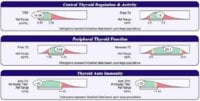
FreeT3=3.59(pg/mL)
RT3=23.1(ng/dL)
RT3/FreeT3=23.1/3.59=6.4
(It is more than 4)
--------------------------
I could also change unints so top and bottom have the same,
(that is how it is ususally done),
but I am not going to do that,
because in article on human dormancy syndrome
that is how they did the ratio.
Invalid Link Removed
As usual, more questions than answers.
------------------------------------
Note that in human dormancy syndrome hi wants to get that ratio to be less than 4..
.-------------------------------
His definition of "human dormancy syndrome" is very broad.
----------------------------------
Reverse T3 is a powerful "off signal" for cells producing changes in insulin receptors, lipoproteins, serotonin, melatonin, oxytocin, nitric oxide synthase and mitochondrial proteins. Meanwhile rT3 can be an "on signal" for nuclei that deepen the dormancy shift by increasing synthesis of prolactin, SP, and antidiuretic hormone (ADH).
-----------------------------------
1000pg=1ng
100mL=1dL
1ng/dL=10pg/mL
------------------
Mr. S's blood work showed a "normal" thyroid pattern with all values within the normal range: TSH=2.90 (0.34-5.60 uIU/mL), free T4=1.0 (0.6-1.6 ng/dL), free T3=2.43 (1.45-3.48 pg/dL), reverse T3 12 (10-24 ng/dL). The ratio of rT3/fr3=4.94.
...
Slow-release T3 instead of Cytomel (instant release) was used for this study to reduce the potential for side effects. The T3 was compounded with methylcellulose to delay absorption and the initial dose was 7.5 ug BID and was well tolerated. His dose was increased to 15 ug BID the following week. His pulse and blood pressure remained stable, his body temperature measured by oral digital thermometer was often low at 95 degrees.
..
This was a significant improvement. His blood work was repeated at his 3 week follow up visit while taking 15 ug BID. His results were all in range: TSH 2.73, fT4 0.6, fT3 2.64, rT3 12, and his ratio of rT3/fT3=4.55 (7.8% decrease/improvement in ratio). His dose of T3 was increased to 22.5 ug AM and 15 ug PM
------------------
It appears that in case of non-specific problems, it may be helpfull to give a try to clearing off RT3 using (Slow-release T3).